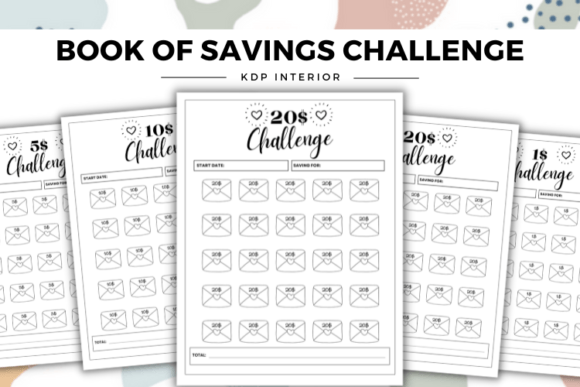
Your Blueprint for Financial Discipline: The 5 Savings Challenge Book Interior
For anyone serious about building a healthier financial future, intention must be met with structure. This is where a dedicated savings challenge planner becomes invaluable. The 5 Savings Challenge Book Interior provides that essential structure. It is a meticulously designed, 110-page printable workbook tailored to guide you through five distinct savings methodologies. More than just a collection of pages, it is a practical tool engineered to transform abstract goals into daily, manageable actions. It fits into the broader process of personal finance management as the operational core—the place where planning meets execution.
Integrating the Workbook into Your Financial Workflow
Effective financial management is a workflow, involving recurring cycles of assessment, planning, tracking, and adjustment. The 5 Savings Challenge Book Interior is designed to slot directly into this cycle. Its utility is not confined to a single moment; it can be deployed at the start of a new financial year, following a major life decision, or as an intervention to break a spending habit. For the professional, freelancer, or entrepreneur with variable income, it offers a consistent framework to maintain savings momentum regardless of revenue fluctuations.
Consider a typical monthly workflow: after reviewing your bank statements, you set a savings target. Here, the book interior acts as your preparation tool. You select one of the five challenge tracks and populate the relevant pages. During the month, it becomes your daily or weekly tracking hub, interacting with your digital tools. You might log a round-up savings amount in the book after checking your budgeting app, creating a tangible, offline record that reinforces your digital data. This hybrid approach combats the abstraction of purely digital finance, making progress physically visible and psychologically rewarding.
Understanding the Five Challenge Frameworks
The interior is organized around five proven savings methodologies, each with its own dedicated sections. This variety allows users to match a challenge to their specific financial personality and current objectives.
- The Round-Up Challenge: This section provides trackers for saving small, incremental amounts, often mirroring digital round-up apps. It’s ideal for building a savings habit without feeling a significant budgetary impact.
- The No-Spend Day Challenge: Calendars and logging pages help you plan and document designated no-spend days, focusing on behavior change and conscious consumption.
- The Percentage Challenge: With tables and progress charts, this challenge helps you commit to saving a fixed percentage of your income, excellent for those with regular earnings.
- The Spare Change Challenge: Trackers for manually logging physical or digital spare change accumulation, promoting mindfulness about even the smallest financial inflows.
- The Weekly Increase Challenge: Structured pages guide you to start with a small base amount and systematically increase your weekly savings contribution, building capacity gradually.
You can run these challenges sequentially to tackle different goals, or concurrently if your financial situation allows. The book’s organization supports this flexibility, enabling a long-term, multi-phase savings strategy.
Practical Implementation and Customization
The provided files—PDF interiors ready for upload to KDP or print, and PNGs—are designed for maximum usability. The large 8.5 × 11 size offers ample space for clear writing and notation. With no bleed required, the process is simplified for both personal printing and professional publishing. For the blogger, educator, or small business owner, this means you can easily download, print, and use the interior immediately, or adapt it as a complementary product for your audience.
To integrate the 5 Savings Challenge Book Interior smoothly, start with a compatibility check. Does your preferred printing method support the PDF size? Do you have a binder or folder to house the printed sheets if you don’t bind it as a book? Next, conduct a brief preparation session. Scan all five challenges and select the one that aligns with your current primary financial goal. Dedicate a specific time—perhaps a Sunday evening—to update your tracker. This ritualization integrates the tool into your routine.
For enhanced efficiency, pair the physical tracker with other assets. Link it to a specific savings account, and note the account’s balance updates in the book. Use it during planning conversations with a partner or financial advisor, making it a central document for collaborative decision-making. Its consistent layout ensures quality control in your tracking; you’re less likely to miss a week or miscalculate because the format guides you.
Maximizing Long-Term Value and Outcomes
The value of a planning tool is measured by its sustained use and the outcomes it facilitates. The 110-page volume of the 5 Savings Challenge Book Interior is calculated for long-term engagement. It allows you to run multiple cycles of a challenge or explore all five methodologies over an extended period. This supports the development of a savings mindset, turning short-term challenges into enduring financial discipline.
Observing your completed pages provides powerful visual feedback on your consistency and growth. This is crucial for motivation. Furthermore, the book serves as a historical record. Reviewing past challenges helps you understand your savings patterns, identify which methods worked best for you, and make more informed plans for future goals, such as saving for a business investment, a educational course, or a major purchase.
Ultimately, the 5 Savings Challenge Book Interior is more than a product; it’s a process catalyst. It takes the common aspiration to “save more” and deconstructs it into actionable, trackable workflows. By providing a clear, organized, and adaptable space to direct your financial efforts, it reduces the friction between intention and result, empowering you to build not just savings, but lasting financial capability.