The To-Do List Notebook Interior: Your Task Management Blueprint
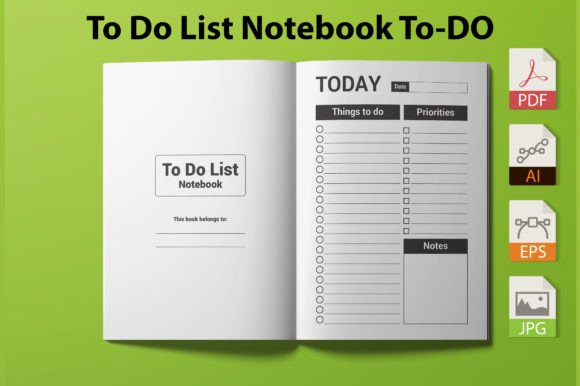
The rhythm of a productive day often starts with a list. For many, that list lives in a notebook—a dedicated space where goals, chores, and ideas transform from mental clutter into actionable steps. A To-Do List Notebook Interior is precisely that: the structured, pre-designed pages inside a notebook, formatted to help you capture, organize, and track your tasks. Unlike a blank journal, it provides a framework. This particular interior is offered as a digital file, giving you the foundation to create your own physical notebook.
You receive a set of high-resolution files—PDF, AI, EPS, and JPG—designed for a 6x9 inch book with no bleed, meaning the content fits safely within the trim area. Available in 101, 111, or 121 pages, the PDF is fully ready for upload to Amazon KDP (Kindle Direct Publishing). It’s an interior-only product; you pair it with your own cover design to create a complete, print-ready notebook for sale or personal use. The value here is in the ready-made structure. It saves you the time and technical effort of designing page layouts from scratch, offering a professional template instantly.
Why a Structured Interior Matters to Different Minds
A simple to-do list is universal, but the way people engage with it varies profoundly. The pre-designed To-Do List Notebook Interior isn't a one-size-fits-all solution, but rather a flexible tool whose significance changes depending on who is using it and what they aim to achieve.
For the beginner venturing into Amazon KDP or physical product creation, this interior eliminates a major hurdle: design. The technical specifications (correct dimensions, no bleed, print-ready PDF) are already handled. Their priority is ease of use and reliability. They can focus on learning cover design and marketing, trusting that the interior’s quality is professionally resolved. It provides a safe starting point, reducing the fear of technical errors that might lead to rejected uploads or poor print quality.
An experienced publisher or entrepreneur, however, might evaluate it through a lens of efficiency and commercial value. They see a ready-to-sell product component. They can rapidly launch a new notebook variation without investing hours in InDesign or Illustrator. Their priority is speed and cost-effectiveness—the download is instant, and the time saved can be redirected to other business areas. For them, the flexibility of having multiple file formats (AI, EPS) is key, allowing for potential customization if they wish to tweak the design later.
The Creator and Professional: Beyond the Basic Checklist
Creators—bloggers, content writers, artists—and professionals—freelancers, marketers, consultants—often need to-do lists that also serve as project logs or idea catchments. A structured interior provides consistency. A blogger might use each page to track article deadlines, research steps, and promotional tasks, creating a visual record of their workflow. The predictability of the layout saves mental energy; they don’t reinvent their system daily.
A freelance graphic designer, for example, might use one page per client project, listing deliverables, feedback dates, and invoice reminders. The clean, professional presentation of the pre-designed pages matters here, as it subtly reinforces a professional mindset. For them, the long-term usefulness comes from creating a tangible archive of completed work and pending tasks, which can be invaluable for time tracking and portfolio development.
Educators, Small Business Owners, and the Quest for Order
Educators juggle curricula, administrative tasks, and student follow-ups. A To-Do List Notebook Interior formatted into a physical notebook could become their command center for the semester. Each page might represent a week, with tasks broken down by class, committee work, and personal development. The priority is organization and learning value—not just for themselves, but as a model they might share with students struggling with time management.
A small business owner, perhaps running a local shop, has priorities that blend daily operations with long-term strategy. They might use the notebook to track inventory orders (daily tasks), employee schedule updates (weekly tasks), and marketing campaign steps (monthly projects). The separation of these into a dedicated, structured space prevents the mix-up that can happen when using random sticky notes or digital apps that feel disconnected. Their evaluation focuses on reliability and presentation—a tool that feels substantial and dedicated to the business’s health.
Hobbyists and Consumers: The Personal Touch
Not everyone approaches a to-do list from a commercial or professional angle. A hobbyist—a gardener, a model builder, a home brewer—might use such a notebook to plan projects, track supply needs, and log progress. Their priority is creativity and the enjoyment of the process. A beautifully structured interior enhances that experience; it feels more like a project journal than a mundane chore list. It adds a layer of ceremony to their passion.
The general consumer, looking for a better way to manage household, family, and personal goals, seeks simplicity and quality. They may download this interior to create a custom notebook for themselves, valuing the ability to have a physical product tailored to their preference (by adding their own cover). They care about the tactile experience and the psychological commitment that writing in a dedicated book can bring. For them, the To-Do List Notebook Interior is a gateway to a more organized life, where the act of writing things down provides clarity and a sense of control.
Identifying Your Match: Goals, Skills, and Projects
How do you know if this digital interior aligns with your needs? Consider your primary intent.
If your goal is to sell a product on Amazon KDP quickly and with minimal graphic design skill, this is a strong match. The provided 100% KDP-ready PDF addresses the core technical requirement. You need only to complement it with a cover.
If your goal is to create a custom personal or team notebook without subscribing to complex design software, the multiple file formats offer a good starting point. Even if you only use the JPG files to print locally, you benefit from the pre-made structure.
If you are an experienced designer looking for a base template to modify, the inclusion of AI and EPS files provides the flexibility you require. You can adapt the layout, change fonts, or integrate branding elements, saving time on the initial grid setup.
Conversely, if you seek a fully finished, unique artistic design or require highly specialized to-do categories (like time-blocking or extreme prioritization grids), this basic interior might be a starting point but will require your additional customization. It serves best those who appreciate a clean, standard to-do list format.
The practical examples illustrate its utility. A freelance writer prints a 121-page version, using it to manage article submissions for three months. A community educator buys a 101-page notebook for a student planning workshop. A small bakery owner uses the 111-page book to track daily baking schedules, supplier orders, and new recipe testing phases. In each case, the pre-designed interior provides the reliable, repeatable framework, while the user fills it with the unique content of their life or work.
In the end, the To-Do List Notebook Interior is more than a digital file; it’s a potential catalyst for order. Whether your drive is commercial, professional, creative, or purely personal, it offers a foundation. By removing the design overhead, it allows you to focus on what matters most: actually doing the tasks on your list.