Navigating Digestive Health: Evaluating the Role of a Structured IBD Food Journal
For individuals managing chronic digestive conditions like Inflammatory Bowel Disease (IBD), Crohn's Disease, Ulcerative Colitis, or IBS, daily management often revolves around understanding personal triggers and patterns. The connection between diet, symptoms, and overall well-being is complex and highly individual. A dedicated tracking tool, such as the IBD Food Journal, emerges as a potential resource in this ongoing process. It represents a specific approach to self-monitoring, designed to compile daily data in a consistent format. Unlike generic notebooks or scattered digital notes, its structure is explicitly tailored for recording meals, symptoms, stress levels, and other factors pertinent to digestive health.
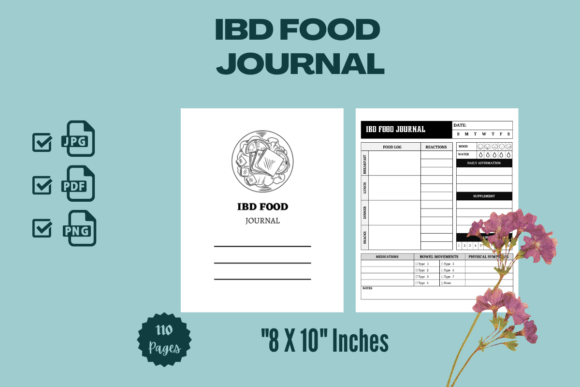
What distinguishes this particular journal is its focused intent. The 8" x 10" physical dimensions offer a substantial page size for detailed entries, while the 110-page count provides a medium-term tracking period. It is offered as a digital PDF file alongside JPG and PNG image variants, indicating its primary distribution as a printable digital product. This format allows for immediate access and the flexibility to print multiple copies or use pages digitally as needed. The absence of a "bleed" in the design means the printable area is contained within standard margins, simplifying home printing. For someone seeking an off-the-shelf, pre-formatted template to begin tracking immediately, this ready-made structure eliminates the time required to design a log from scratch.
Comparison with Common Tracking Approaches
When evaluating the IBD Food Journal, it is useful to consider it alongside the broader categories of tracking methods people commonly employ. Each approach carries different strengths and tradeoffs related to convenience, depth of analysis, and personal habit alignment.
Generic Notebooks or Planners
A blank notebook offers maximum flexibility. You can draw custom charts, write free-form notes, and adapt the layout daily. However, this freedom requires consistent personal discipline to maintain useful structure. Without predefined sections, it's easy to omit crucial details like medication times or symptom severity scales, leading to incomplete data. The IBD Food Journal, by contrast, provides that framework upfront. Its value lies in guiding the user to record specific data points consistently, which is critical for identifying patterns over weeks or months. The tradeoff is a loss of total customization; you work within its provided layout.
Digital Apps and Spreadsheets
Many specialized mobile apps exist for symptom and food tracking. They offer advantages like data export, graph generation, and reminders. Their limitations can include subscription costs, overly complex interfaces, or dependence on device use—which some users find disruptive during meals or when symptoms flare. A printable PDF journal like the IBD Food Journal exists outside the digital ecosystem. It can be more accessible during times when screen use is undesirable, and it doesn't require battery life or internet access. The primary drawback is manual analysis; you must review pages visually to spot trends, whereas an app might automate some correlations.
Pre-formatted Paper Journals from Other Sources
Some health organizations or clinics provide free PDF tracking sheets. These are often excellent starting points but may be limited to a single-page design or lack space for extended commentary. The 110-page count in this IBD Food Journal suggests a commitment to longer-term tracking, potentially covering several months. The inclusion of multiple file formats (PDF, JPG, PNG) also offers more versatility for users who might wish to import pages into other digital note-taking systems compared to a single PDF. However, its comprehensiveness should be weighed against individual needs: someone requiring highly specialized fields, like detailed stool categorization or joint pain tracking, might need to supplement this journal's structure.
Key Decision Factors and Best-Fit Scenarios
Choosing any health management tool involves assessing how its features align with your specific situation, habits, and goals. The IBD Food Journal may be a particularly strong fit under certain circumstances, while other options might be preferable elsewhere.
A realistic example is someone newly diagnosed or beginning a new treatment protocol. The learning curve is steep, and a structured journal can reduce the cognitive load of "how" to track, allowing focus on "what" to track. The preset columns for food, symptoms, and notes create a simple routine. For individuals collaborating with a gastroenterologist or dietitian, having a standardized, chronological record can facilitate clearer communication during appointments. Presenting a physical journal or printed pages from the IBD Food Journal can help a professional quickly scan a patient's history.
The journal's format also suits people who prefer tactile, offline activities. Writing can be a mindful practice, and for some, the act of physically recording meals fosters greater awareness and accountability than typing on a phone. Conversely, the journal would be a less optimal fit for someone who travels incessantly and prefers minimal baggage, or for a person who already uses a comprehensive digital health platform that integrates with their clinician's system. In those cases, carrying a paper journal or managing printed sheets could feel like an inefficient duplication of effort.
Another consideration is the analysis phase. The IBD Food Journal is a data collection tool. Its ultimate value is realized only through regular review. A user must be prepared to periodically look back over entries to hypothesize connections—for instance, noticing that high-stress days consistently precede symptom flares, or that certain foods appear problematic only when combined. If a user collects data but lacks the time or skill for review, a tool with built-in analytics, even a simple spreadsheet with charting functions, might offer more immediate insight.
Understanding Limitations and Potential Supplementary Needs
No single tool is universally complete. Recognizing the boundaries of the IBD Food Journal helps in planning a holistic management strategy. Its design, as described, focuses on daily logs. It likely does not include expansive educational sections on IBD nutrition, medication guides, or emergency contact pages. These are elements some commercial physical journals include. Therefore, a user might pair this printable journal with reputable online resources or handouts from their care team for reference information.
The digital-only nature of the product is a key practical point. It requires access to a printer for physical use. For those without easy printing capabilities, the PDF could be used on a tablet or computer with a note-taking app that allows annotation, though this might alter the intended pen-and-paper experience. Furthermore, while the 110 pages offer volume, the journal does not automatically create summaries or highlights. This places the onus of synthesis on the user. One could argue this is a benefit, as it encourages direct engagement with one's own data, but it is a limitation in terms of time-saving automation.
When comparing within the category of printable health journals, the specific dimensions and page count are factors. An 8" x 10" book is larger than a standard pocket notebook but smaller than a full-sized binder. It is a compromise between portability and writing space. Some may find it ideal for a kitchen counter or bedside table; others might prefer a smaller format for a purse or backpack. The page count of 110 suggests it is not a perpetual journal; it will be filled and require replacement or supplementation. This can be a positive, marking a clear period of focused observation, or a negative for those seeking a single, long-term repository.
Making an Informed Choice for Your Management Toolkit
The decision to integrate an IBD Food Journal into your health practice ultimately hinges on your personal workflow, learning style, and the specific gaps you are trying to address in your current management approach. If your current method is inconsistent or you feel your dietary records are too fragmented to analyze, a structured template can bring necessary order. Its printable nature offers a quick start without waiting for a shipped physical product.
It is also reasonable to consider a phased approach. You might begin with this IBD Food Journal for a dedicated 90-day period to establish baseline patterns, then transition to a different method—like a customized digital tool—for longer-term maintenance based on what you learned. Alternatively, you could use it concurrently with other resources; for example, using the journal for detailed daily food and symptom logging while using a simple app to track only medication adherence.
Evaluating any health journal involves asking practical questions: Will I actually use this format daily? Do I have a simple way to print and bind it if I want it physical? Does its structure cover the variables my doctor has asked me to monitor? Are there critical data points I need to track that it doesn't include, and can I easily add them? Answering these helps move beyond a generic "is this good?" assessment to a personalized "is this good for me?" evaluation.
Tools like the IBD Food Journal serve as facilitators of awareness. Their core benefit is not in the product itself, but in the consistent, structured data it helps generate, which empowers you and your healthcare providers to make more informed choices about your health and lifestyle. Whether this particular journal is the right catalyst for that process depends on how its specific form—a printable, pre-formatted, multi-page tracker—matches your individual needs for structure, accessibility, and analysis depth in managing digestive health.