The Gardening Journal KDP Interior: Your Essential Tool for Organized Growth
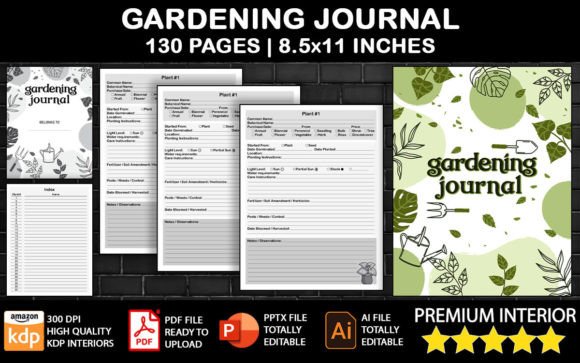
For any gardener, from the weekend enthusiast to the seasoned horticulturist, the true joy comes from watching things grow. Yet, the details that make that growth successful—the exact planting date of a cherished heirloom tomato, the specific sunlight hours a new shrub received, the first bloom of a perennial—often fade from memory. This is where a dedicated gardening journal becomes invaluable, and for creators and gardeners alike, the Gardening Journal KDP Interior offers a uniquely powerful solution. It's not just a notebook; it's a professionally designed, editable template system built specifically for logging up to 120 plants with meticulous detail, ready for you to publish or use personally.
The Common Pitfall: Scattered, Incomplete Records
Many gardeners start with the best intentions, jotting notes on seed packets, calendar margins, or random sticky notes. This approach quickly leads to a critical mistake: fragmented data. When your notes on watering requirements for your lavender are in one place, the pest problem you observed last July is in another, and the planting instructions are lost entirely, you lose the ability to learn from your own experience. This fragmentation directly affects your gardening results. You might over-water a plant next season because you forgot its specific needs, or repeat a poor planting location choice because you didn’t record the sunlight patterns. The Gardening Journal KDP Interior corrects this by providing a unified, structured layout for every plant, consolidating details like planting date, location, instructions, water, sunlight, bloom date, and pest problems all in one dedicated space per plant.
Overlooking the Importance of Editable Formats
A significant misunderstanding when choosing a gardening journal template is focusing only on the final look and not on the flexibility to adapt it to your specific needs. You might find a beautiful PDF, but if your garden expands or you want to add a custom section for soil pH tracking, you're stuck. The Gardening Journal KDP Interior provides both a ready-to-upload PDF and an editable PPT file. This means you can add pages, adjust categories, or personalize headings before publishing on KDP or before printing for personal use. Ignoring this editable capability can limit the journal's long-term usefulness and force you into a rigid system that doesn’t match your evolving gardening practice.
A better approach is to assess your own recording style first. Do you need extra space for fertilizer schedules? Perhaps you want a section for rainfall tracking. With the editable PPT file, you can incorporate these seamlessly, ensuring the journal grows alongside your garden.
Why Resolution and Preview Testing Matter
For creators publishing on KDP, and for gardeners expecting a high-quality print, the technical specifications are often overlooked details that drastically affect satisfaction. Using a template with low-resolution graphics or improper bleed settings leads to a final product that looks blurry, unprofessional, or has misaligned margins. The Gardening Journal KDP Interior is built with high-quality resolution for both cover and interior, and the files are tested in the KDP Previewer. This pre-testing is a crucial step that avoids the frustration of upload errors or a poor print outcome. Before using any template, you should always check it against the platform’s requirements. This journal does that work for you, providing confidence that the 8.5x11 inch trim size with bleed is correctly configured.
The Mistake of Underestimating Scope
Another common error is choosing a journal with too few pages. A 50-page journal might seem sufficient, but for a gardener seriously tracking vegetables, annuals, perennials, flowers, shrubs, trees, bare root stocks, ground cover, fruit, and herbs, space runs out quickly. This journal offers 130 pages, which is thoughtfully calibrated for 120 plant entries plus additional logistical pages. More importantly, the design philosophy is clear: “You are free to add more if you want.” This empowers you to scale the journal to your project’s true scope without starting from scratch. A limited page count forces you to either stop recording or buy another journal, breaking the continuity of your data.
Consider a realistic example: You plant 30 vegetable varieties, 15 perennials, 10 shrubs, and 20 herb types in a single year. That’s 75 plants already requiring detailed logs. With room for 120, you have space for years of growth and notes on each plant's performance over time, which is the core of intelligent gardening.
Practical Advice for Creators and Gardener-Users
Before deciding to use the Gardening Journal KDP Interior, whether for KDP publishing or for personal garden management, take a moment to define your end goal. If you're a creator, verify that you have access to software that can handle the provided AI and EPS files for cover editing, which offer maximum design flexibility. If you're a gardener planning to print it locally, the PDF interior is perfectly ready. For everyone, explore the editable PPT file first. Add a sample entry for a fictional plant to see how the structure works for you. This hands-on test reveals the template’s logic and ensures it matches your recording habits.
Avoiding the “One-Size-Fits-All” Assumption
While the journal is designed to be comprehensive, the best way to use it is to personalize its application. A misunderstanding is to try to fill every field for every plant rigidly. Some plants might not have a “bloom date,” but you might have a “first harvest date” instead. Use the fields as guides, not absolutes. The editable nature supports this. The practical advice is to start simple: Log your first 10 plants using the provided categories. As you use it, you’ll naturally discover which details are most critical for your specific climate and garden style, and you can then tweak the template for future seasons or editions. This turns the journal into a living document, improving your gardening efficiency and the quality of your records each year.
Ultimately, the Gardening Journal KDP Interior bridges the gap between passion and organization. It helps you avoid the poor decisions that stem from forgotten details and disjointed notes. By providing a tested, high-quality, and adaptable framework, it ensures that your focus remains on the joy of gardening, supported by a system that learns and remembers alongside you. Whether you’re publishing it for other gardeners or utilizing it for your own plots, it represents a smart, foundational choice for anyone serious about cultivating both plants and knowledge.