The Art and Strategy of Crafting Coloring Book Designs for KDP Interior
In the expansive digital marketplace of Amazon Kindle Direct Publishing (KDP), a particular niche has blossomed into a vibrant and lucrative field: the creation and sale of coloring book interiors. This venture transforms the simple joy of coloring into a structured business opportunity for creators. At its core, this process involves designing printable pages that are both aesthetically pleasing and mechanically functional, tailored to meet the specific technical and commercial requirements of the KDP platform.
Understanding the KDP Coloring Book Ecosystem
Amazon KDP provides a direct avenue for authors and designers to publish and sell physical books without the complexities of traditional printing and distribution. Within this system, interior design refers to the actual content pages of the book—the artwork, layouts, and formatting that customers will interact with. For a coloring book, the interior is not merely text; it is a curated collection of illustrations awaiting color.
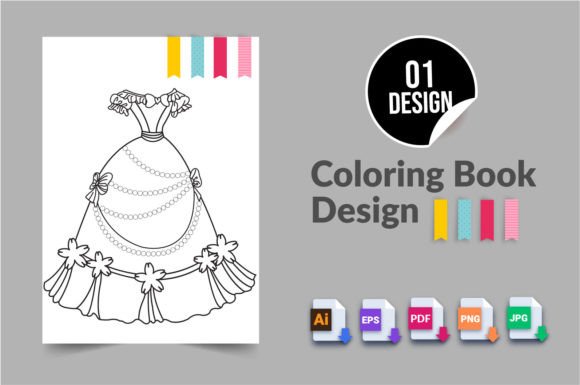
The typical download for such a project, as often seen in market offerings, includes a suite of file formats: an Ai file for advanced vector editing in Adobe Illustrator, an EPS file for compatibility with various design software, a PDF for universal printing and viewing, along with PNG and JPG versions of the coloring page for immediate use. These files, prepared at dimensions of 8.5″ x 11″ inches, represent the raw materials from which a full, sellable book is assembled.
Core Components of a Professional Interior Package
A robust coloring book design package serves multiple purposes. The AI and EPS files are crucial for creators who wish to modify the designs at a foundational level, altering lines, adding elements, or restructuring compositions. The PDF often acts as the final, polished document ready for upload to KDP, ensuring all pages are correctly ordered and formatted. The individual PNG and JPG files provide flexibility; they can be used as standalone digital sheets, incorporated into other projects, or used to create additional page variations by combining or editing images.
The insistence on high-resolution interiors is non-negotiable. When a customer prints a physical book via KDP, clarity and sharp line work are paramount. Blurry or pixelated illustrations degrade the user experience and can lead to negative reviews. Therefore, designing with vector graphics or at a very high pixel density from the start is a standard professional practice.
The Imperative of Originality and Customization
A critical consideration in this field is the avoidance of duplicate content. Amazon’s systems scan for books that share identical or overly similar interiors. Using a template exactly as provided, without modification, carries risk. The advice to make a template “ALL YOUR OWN” by adding, deleting, rearranging pages, altering clip art, changing page titles, or inserting new quotes is not merely a suggestion—it is a strategic necessity for long-term viability.
This transforms the designer’s role from a passive user to an active creator. One might start with a base set of six cute animal coloring pages, but the final product could be expanded to fifty pages through combination, the introduction of thematic backgrounds, the addition of motivational phrases beside the illustrations, or the creation of entirely new pages inspired by the original style. This process of significant customization establishes originality, which protects the publisher and enhances the book’s unique value in a crowded marketplace.
Practical Applications Across User Groups
The utility of a well-designed coloring book interior extends to a surprisingly broad audience. For the solo entrepreneur or small business owner, it represents a ready-to-market product for a high-content book business. With a tested template, they can focus their efforts on crafting a compelling cover and managing marketing, rather than mastering complex design software from scratch.
Educators, particularly those working with kindergarten or early-grade students, can utilize these designs to create custom activity books for their classrooms, focusing on specific learning themes like animals, letters, or numbers. Hobbyists and art enthusiasts might purchase such interiors to enjoy the coloring pages themselves or to share with family, appreciating the convenience of professionally drawn artwork. Furthermore, other creators can use these files as components within larger projects, such as activity packs or themed gift sets, demonstrating the modular nature of the digital assets.
Technical Considerations for KDP Success
Success on the KDP platform hinges on understanding both design and publishing mechanics. The standard 8.5″ x 11″ inch dimension aligns with the common trim sizes offered by KDP for coloring books, ensuring no awkward scaling or cropping occurs during the print-on-demand process. Each file format in the ZIP package serves a distinct role in the workflow. The vector files (AI, EPS) allow for scalability and editing without quality loss. The PDF is typically the final upload file, and its internal setup—including margins, bleed settings, and page order—must be meticulously checked against KDP’s guidelines.
Testing the interior fully in the Amazon KDP platform, as mentioned, is a vital step. This involves uploading the PDF, reviewing the digital previewer, and sometimes ordering a physical proof copy to check print quality, binding, and how the colors (if any are used in the line art) translate to monochrome printing. This proactive testing mitigates the risk of publishing a flawed product.
The inclusion of both adult and kid-focused designs, such as in a set of six cute coloring pages, highlights the importance of audience targeting. Designs for adults might feature more complex patterns, intricate mandalas, or sophisticated animal portraits, while those for children emphasize bold, clear lines, friendly characters, and simpler compositions. A versatile interior package that caters to both can be a more marketable asset.
Strategic Keyword Integration and Market Positioning
From an SEO and discoverability perspective, the language used to describe and list the book is crucial. Natural semantic variations of key terms—like “Animal Coloring Pages,” “Coloring Book Design,” “Coloring Page for Kids,” “Printable Coloring Sheet”—should be woven into the book’s title, description, and backend keywords on KDP. This helps the product appear in diverse search queries without resorting to repetitive or spammy phrasing. The article itself, by discussing “Coloring Book Design for KDP Interior” within a context of strategy, application, and customization, mirrors this best practice, providing helpful content that addresses the informational needs of potential creators.
The real-world relevance of this topic is clear. It connects the creative act of drawing with the practical demands of e-commerce, offering a path for artists to monetize their skills and for entrepreneurs to enter a popular market with a relatively low barrier to initial production. The characteristics of a good project—high-resolution files, multiple formats, customizable content, and platform-ready formatting—are directly tied to its advantages: reduced technical hurdle, faster time-to-market, and a foundation for building original content.
Ultimately, crafting a coloring book interior for KDP is more than just drawing pictures. It is a holistic process involving artistic design, technical preparation, strategic customization for originality, and an understanding of a specific digital marketplace. Whether the end user is an adult seeking relaxation, a child engaged in play, a teacher looking for resources, or a business owner building a catalog, the quality and thought invested in the interior design determine the success and satisfaction derived from the final product.