Math Tricks for Kids Ages 8-14 Years: A Practical Guide to Building a Strong Foundation
Mathematics is often seen as a daunting subject, yet its mastery unlocks critical thinking and problem-solving skills essential for the modern world. For parents, educators, and creators looking to support young learners, the challenge isn't just about teaching math—it's about making it accessible, engaging, and relevant. This is where Math Tricks for Kids Ages 8-14 Years becomes a vital resource. This comprehensive guide is designed to transform complex concepts into intuitive, visual strategies that children can grasp and apply confidently.
The Shift from Memorization to Understanding
The traditional approach to math education heavily relied on rote memorization and repetitive drills. Today, there's a significant evolution towards conceptual understanding and flexible thinking. In a landscape shaped by technology and rapid information processing, the ability to understand *why* a method works, and to apply it in varied contexts, is more valuable than simply knowing *how* to perform a calculation. This 62-page guide, prepared with Affinity Publisher and KDP-ready at 8.5x11 inches, aligns perfectly with this shift. It offers all source files supplied and permitted for editing, allowing educators and content creators to adapt the material to specific classroom needs, homeschooling curricula, or supplementary learning modules.
The age range of 8-14 years is particularly crucial. It bridges the gap from foundational arithmetic to more abstract pre-algebra concepts. During these years, students can develop either a lasting confidence or a persistent anxiety towards math. By introducing mathematical thinking through tricks and visual models—like Spin Multiplication, Box Multiplication, and Ladder Multiplication—the guide builds a positive framework for learning that feels more like exploration than instruction.
Core Concepts Explained Through Visual Tricks
The guide's strength lies in its practical breakdown of essential topics into manageable, strategy-based lessons. Here's how it approaches key subjects:
Mastering Multiplication Beyond the Table
Moving past the times table, the guide introduces multi-dimensional methods. Spin Multiplication and Box Multiplication (often related to the grid or area method) visualize multiplication as a combination of parts, reinforcing the distributive property. Ladder Multiplication can serve as a step-by-step scaffold for larger numbers. Techniques like Repeated Add Multiplications and using Arrays ground abstract operations in concrete, countable representations. These aren't just shortcuts; they are building blocks for algebraic thinking later on.
Foundations of Number Theory and Operations
A solid grasp of number types is fundamental. The guide covers Prime Numbers and Even & Odd Numbers not as isolated facts, but as properties that influence operations and problem-solving. Understanding these concepts early helps with factorization, which is directly applied in lessons on Least Common Factors (LCF) and Greatest Common Factors (GCF)—critical skills for working with fractions.
Demystifying Fractions and Decimals
The fraction module is comprehensive and sequential. It begins with understanding the concept of Fractions visually, then progresses to operations: how to Add, Multiply, and Subtract Fractions. It tackles the often-confusing area of Proper and Mixed Fractions, ensuring students can convert and operate seamlessly between forms. This logical progression naturally extends into Decimals and Percentages, linking these representations to show they are different expressions of the same proportional relationships.
Building a Bridge to Algebra
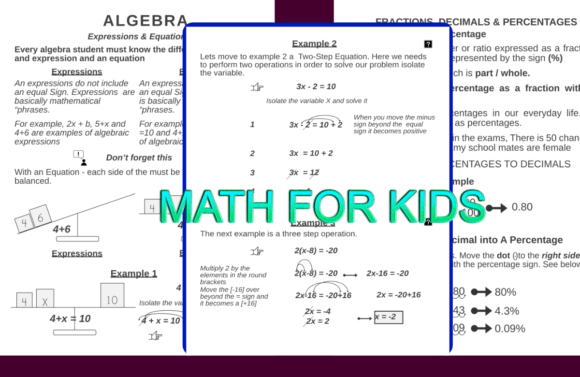
The ultimate goal of these foundational tricks is to pave a clear path to Algebra. When a child understands multiplication as an area (Box Method), they are prepped for understanding variables and formulas. When they master fractions and factors, they are ready to solve equations with rational numbers. The guide’s comprehensive approach ensures that algebra isn't a sudden, scary new subject, but a natural extension of the logical tools they've already acquired.
Practical Implications for Users and Creators
The relevance of this resource extends beyond the child's workbook. For professionals, entrepreneurs, and educators in the educational content space, it represents a ready-to-use, adaptable product.
- For Educators & Homeschooling Parents: The supplied source files mean you can tailor pages, create additional practice sheets, or integrate sections directly into your lesson plans. The visual methods serve as excellent classroom demonstrations.
- For Content Creators & Bloggers: The material provides a deep well of topic-specific explanations that can be broken down into blog posts, video tutorials, or social media content focused on math education trends and parental support.
- For Freelancers & Business Owners in EdTech: The structured, KDP-ready format illustrates how niche, practical educational guides meet a clear market need—supporting parents seeking alternatives to generic textbooks.
The modern workflow in education increasingly blends physical and digital resources. A professionally designed, print-ready guide like this one can be the centerpiece of a hybrid learning kit, complemented by digital apps or online practice. Its design caters to current user expectations for clean, clear, and visually supportive instructional material.
Why Visual Math Tricks Are Gaining Attention
There's a growing recognition that STEM success requires early, positive engagement with math. Anxiety around the subject is a significant barrier. Visual tricks and non-traditional methods reduce this anxiety by providing multiple "ways in" to a problem. If a student struggles with standard algorithmic multiplication, the Box Method offers a spatial, piece-by-piece alternative that often clicks. This multi-modal approach aligns with broader educational trends toward differentiated instruction and universal design for learning.
Moreover, in a world where data literacy and quantitative reasoning are essential for professionals across fields—from marketers analyzing metrics to entrepreneurs forecasting finances—the foundation built in these middle school years is more critical than ever. A resource that makes this foundation strong and enjoyable is not just an academic tool; it's a life skills investment.
Realistic Application and Recommendations
Implementing these tricks effectively requires more than just handing a child the book. Consider these observations:
- Integration Over Isolation: Use the tricks as part of a broader learning conversation. Connect Spin Multiplication to real-world problems like calculating total items in multiple packs.
- Progress at the Child's Pace: The 8-14 age range is broad. An 8-year-old might focus on Arrays and Repeated Addition, while a 12-year-old delves into Fractions and GCF/LCF. The guide's structure allows for this staggered progression.
- Emphasize the "Why": Always link the trick back to the core mathematical principle. Explain that the Box Method shows why 23 x 15 equals (20 x 15) + (3 x 15). This builds true understanding, not just procedural fluency.
For the adult reader—whether a parent, a teacher, or a creator—this comprehensive guide on math tricks for kids represents a practical, editable, and professionally prepared asset. It meets a clear need in today's educational landscape: turning potential frustration into curiosity and competence, setting the stage for academic confidence and real-world numerical literacy.